Wen Shen

Contradiction

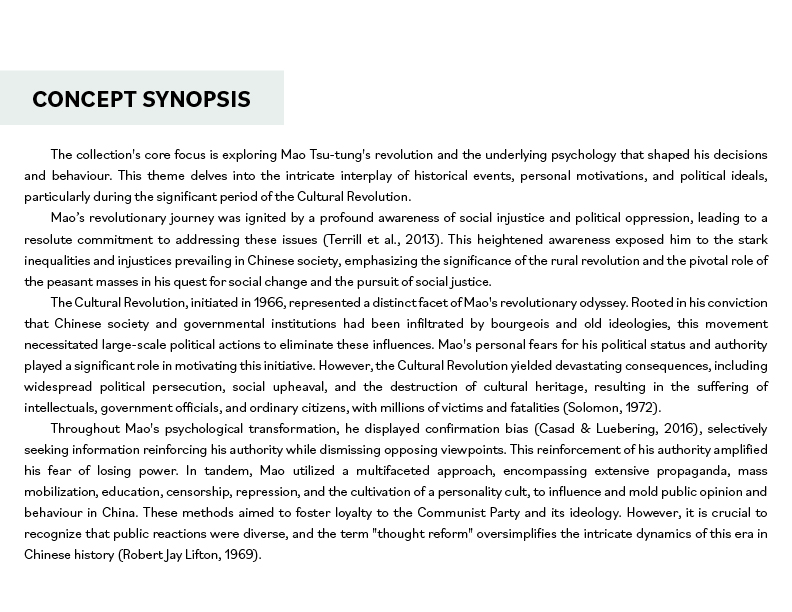
Within the collection, the central theme revolves around delving into Mao Tsu-tung’s revolution and the psychological factors that shaped his decisions, with a particular focus on the Cultural Revolution. The primary exploration emphasizes the intricate interplay of historical events, personal motivations, and political ideals. At its core, Mao’s commitment to addressing social injustice and political oppression reflects a response to the structural violence ingrained in Chinese society (Terrill et al., 2013). The Cultural Revolution, initiated in 1966, stands out as a pivotal aspect of Mao’s revolutionary journey. Rooted in his conviction that Chinese society and governmental institutions were tainted by bourgeois and old ideologies, this movement necessitated large-scale political actions to eliminate these influences. Mao’s personal fears for his political status and authority played a significant role in motivating this initiative, resulting in widespread consequences such as political persecution, social upheaval, and the destruction of cultural heritage. The suffering endured by intellectuals, government officials, and ordinary citizens, with millions of victims and fatalities, underscores the profound impact of Mao’s actions (Solomon, 1972). Mao’s psychological transformation is evident in his display of confirmation bias, selectively seeking information that reinforced his authority while dismissing opposing viewpoints (Casad & Luebering, 2016). This reinforcement of authority heightened his fear of losing power, leading to a multifaceted approach encompassing extensive propaganda, mass mobilization, education, censorship, repression, and the cultivation of a personality cult. These methods aimed to influence and mold public opinion and behavior, fostering loyalty to the Communist Party and its ideology. It is crucial to acknowledge the diversity of public reactions during this era, emphasizing that the term “thought reform” oversimplifies the intricate dynamics of Chinese society grappling with structural violence (Robert Jay Lifton, 1969). The collection seeks to illuminate these complex historical and psychological dimensions, providing a nuanced perspective on Mao’s revolutionary legacy and its impact on Chinese society.

InstagramWebsite

Media

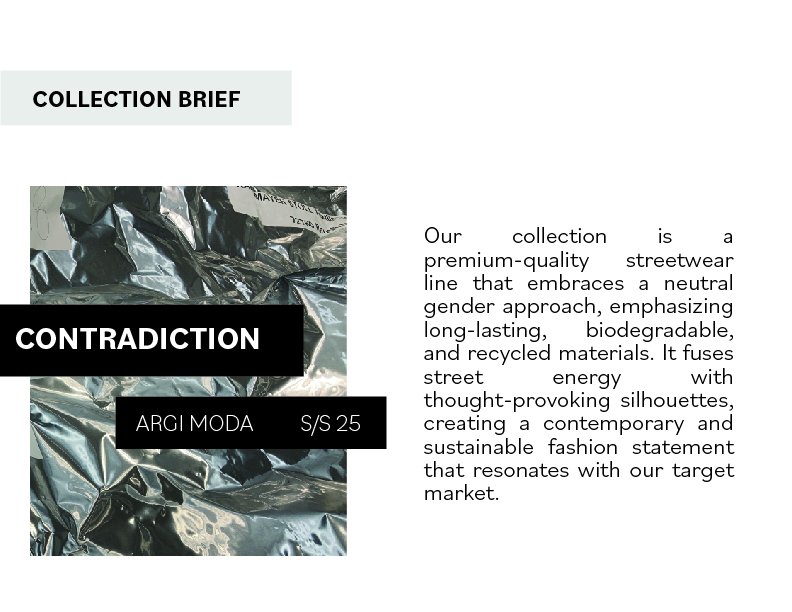
A presentation slide with 'COLLECTION BRIEF' at the top left. The left side features a textured image of crumpled, shiny dark silver material. Overlaid on this image are two black bars: the upper one reads 'CONTRADICTION' and the lower one 'ARGI MODA S/S 25'. The right side contains a paragraph describing the collection as a premium-quality, neutral-gender streetwear line emphasizing long-lasting, biodegradable, and recycled materials, fusing street energy with thought-provoking silhouettes to create a contemporary and sustainable fashion statement.
A page titled 'CONCEPT SYNOPSIS' detailing Mao Zedong's Cultural Revolution, explaining its roots in Mao's psychology and fears, its aim to eliminate 'bourgeois and old ideologies,' and its severe outcomes including widespread persecution, destruction of heritage, and millions of victims. It also mentions Mao's use of confirmation bias and tactics like propaganda and censorship to maintain authority.
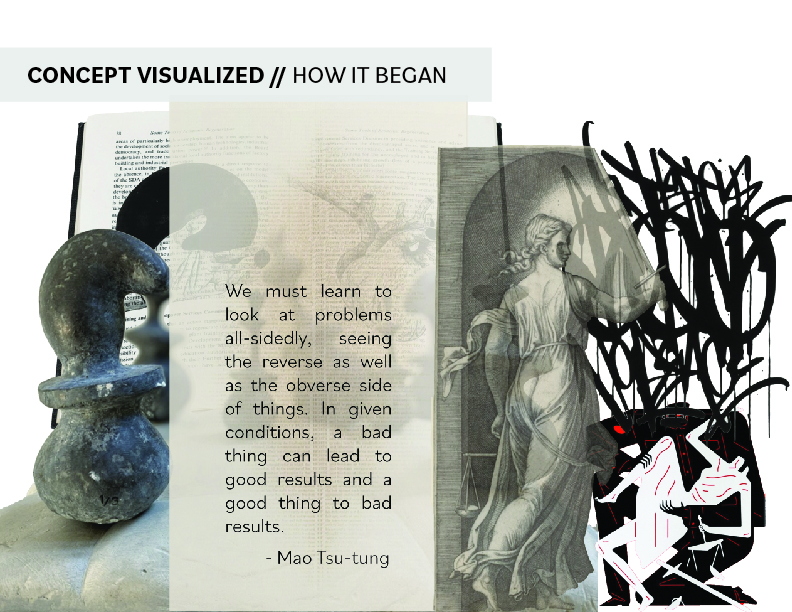
A complex collage titled 'CONCEPT VISUALIZED // HOW IT BEGAN'. The left shows an open book and a weathered gray metal weight. In the center, a panel with an antique paper texture displays a quote by Mao Tse-tung about looking at problems 'all-sidedly' and how 'a bad thing can lead to good results and a good thing to bad results.' The right side features a classical engraving of a robed woman, possibly Lady Justice holding scales, partially covered by a large, chaotic black graffiti-like scribble. Below this, two stylized figures in white and red outlines struggle against a dark background, in a modern graphic art style.
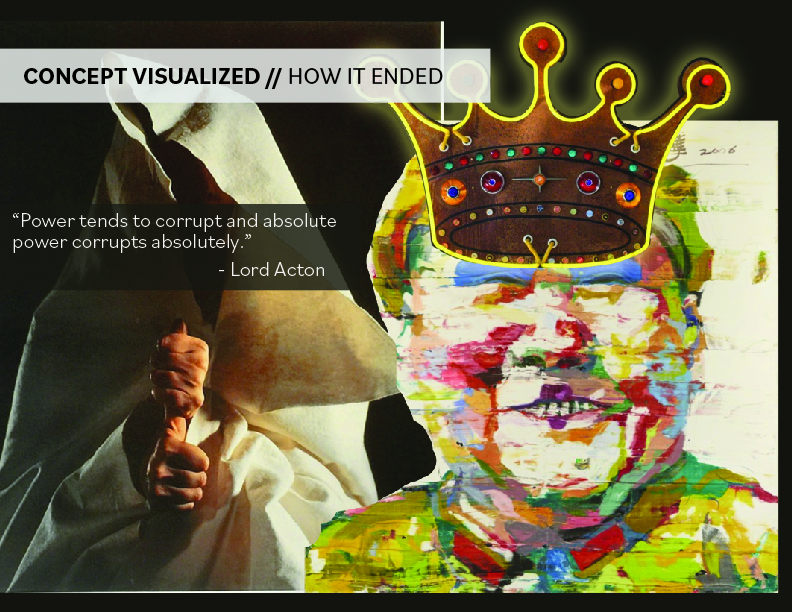
The image, titled 'CONCEPT VISUALIZED // HOW IT ENDED', features a shadowy figure in a white hooded robe giving a double thumbs-up on the left. Overlaid is the quote: 'Power tends to corrupt and absolute power corrupts absolutely.' - Lord Acton. On the right, a highly abstract, colorful, and distorted portrait of a smiling person, created with thick brushstrokes of red, blue, yellow, and green, wears a large, ornate, glowing golden crown adorned with jewels.
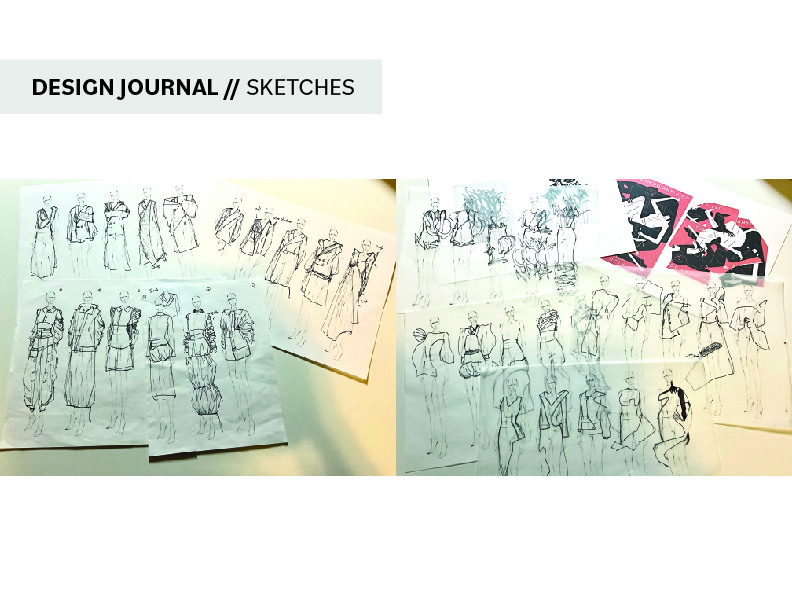
A flat lay image showcasing numerous fashion design sketches in black ink on white and translucent paper, depicting diverse clothing styles on minimalist figures. Some sheets are layered, revealing underlying drawings, and one sheet on the right features abstract black and red patterns. A prominent grey banner at the top left corner displays the text 'DESIGN JOURNAL // SKETCHES'.
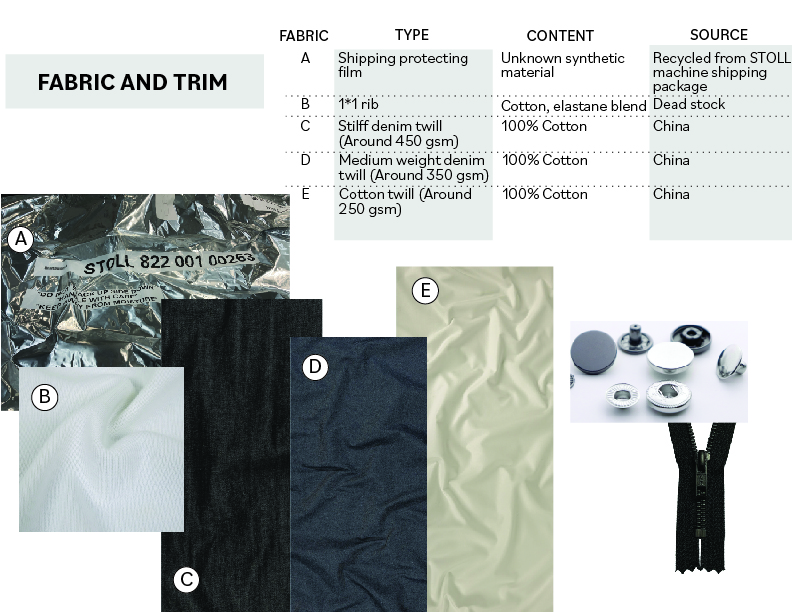
A comprehensive display of 'FABRIC AND TRIM' components. On the left, visual samples are arranged: (A) crumpled silver shipping film with a STOLL label, (B) a swatch of white 1x1 ribbed knit fabric, (C) dark grey stiff denim twill, (D) dark blue medium-weight denim twill, and (E) light beige cotton twill. To the right, a table provides details for each fabric type, including its content (e.g., cotton, elastane, synthetic) and source (e.g., recycled, dead stock, China). Further right, images show various snap fasteners in different finishes and a black zipper, representing additional trims.